Tuesday, July 15, 2014

< 10!

That is how many days until I start my journey back to the Falklands. I can't believe how quickly almost 4 months has passed since the last trip. This trip will be drastically short in relation to the others though. We leave 24 July, arrive to Stanley, FI Saturday, 26 July, arrive on Saunders Island 27 July (weather permitting), and then turn around on 7 August to begin to travel back, arriving home 11 August. 18 days total, that's it! We were supposed to leave a week earlier but since you can only fly in and out of the islands on Saturday, that plane was booked. I am a little worried about how much work will actually be completed in just 10 days on Saunders Island. However, our newest member of the team, Anna, will at least gain an introduction to Falkland life. She will be working under the advisement of Dr. Marc Bechard for her Master of Science degree. 

I have kept pretty busy during my hiatus from the Islands though. I was able to meet some of my devoted blog followers when I presented to the 5th graders at Sturgis Elementary (they were the students that asked me all sorts of questions during my last trip -- you can read that entry here). 

How many Apple products does it take to create a presentation?
One of the two 5th grade classes I presented to. They were AWESOME!
I have also went back to my job at Panera Bread. I truly have a love/hate relationship with this job. 

Things I hate about it: 
1. Rude customers who make you feel worthless. There have been so many instances where I want to scream, "I (probably) have more degrees than you! Just because I ask you if you want a drink with your order does not mean you have the permission to treat me with so much disrespect!"

2. The feeling of being unappreciated by both customers (see number 1) and by Panera itself. 

3. Since moving (oh yes, that happened too since I got back) it now takes me every bit of a half hour to get to work.

4. I now help with Panera's catering and it boggles my mind when people place a $400+ order, have free delivery, and still don't include a tip. Do they not tip when they order a $10 pizza and have it delivered to their house?

Things I love about it:
1. I have worked for Panera Bread on and off since I was laid off from PetsMart at the tender age of 16. My general manager, Brian, is amazing and understanding, and lets me leave and come back. He also lets me work mornings. Despite me not being a morning person, I would rather get my shift done early in the day (5am starts have become the norm for me). 

2. Another plus of working mornings is that customers tend to be a little nicer than the lunch rush. These morning customers also include "the regulars." I have nicknamed a group of five, "The Breakfast Club" (David, Don, Margaret, Dennis, and Carol). I also have the sweetest, most devoted couple, Mark and Susie, but they usually visit later in the morning. These individuals make your busy morning better no matter how crappy it started. You also become invested in them and they become invested in you too, if you are lucky.  For example, David is from England and also followed my blog during my last trip and he would keep the other four up-to-date on what I was doing for the two months I spent in the Falklands. He had asked me if I was willing to do a presentation of my research for him and his friends. Of course I agreed and that is how I gave my first in a brewery. Kuhnhenn Brewing Co. to be exact.
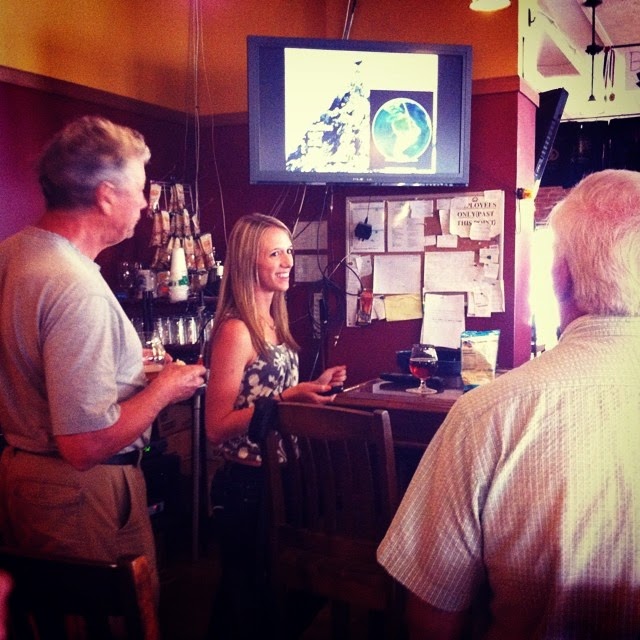
My fellow biologist friends were jealous of my location. I would have been too.
Since I truly enjoy talking about my research and about the Falklands, I will always jump at a chance to educate others about this special place and its Johnny Rooks. I never expect anything more than the opportunity to broaden the knowledge of conservation to people to come out of my presentations. So, it was quite a surprise that through this presentation I gained two donors (I won't say who in case they want to remain anonymous). I am forever grateful and touched that they think so much of me to be willing to donate their hard-earned money to my research. Without Panera this never would have happened. (Want to join the donation team? Let me know!)

3. By working at this Panera location I am given the opportunity to meet a lot of corporate Moosejaw employees (Moosejaw is an awesome local Michigan backpacking and outdoor store). After getting to know one employee that comes in regularly and who took an interest in my research, I was gifted with some warm clothes for this upcoming trip. Thank you Moosejaw! 

Another thing that happened during this hiatus is that BBC aired the show (in the UK and its territories) that was filmed while I was in the Falklands. Appropriately, the Johnny Rooks were the stars of the segment, but my hat and hand did manage to make the final cut into the episode! Woo!
That hand and hand in the bottom right photo belong to me. I am basically a TV star now, I know. (jk)
On a less uplifting note, I still have not been able to find a professor that has funding for a stipend for basic living and tuition so it looks as though I will have to wait another year to start school. I have been trying to come to terms with this idea for a while, and sadly I am still holding out hope that something will turn up. In the meantime though, I have been applying to other jobs for the Fall that will make me feel more significant (e.g., research jobs, adjunct instructors at colleges, etc.). I also will have my first published article as first author come out in the next Journal of Raptor Research. There are more papers in the works too, so that will hopefully help my mental state. This is not where I thought I would be if you asked me two years ago, but like many people have told me, it is all happening for a reason. Even if I don't currently understand, it is for the best, and it is okay. 

Tuesday, April 15, 2014

Now Showing...(1/2)


This puzzle was never shown to them before. Okay, that's a partial lie. This video is of the 5th try because we had to keep modifying it before then (see, this post). Thank God, the BBC Deadly crew took it in stride and were patient (Steve Backshall is in the background). Luckily a smart adult Johnny Rook was around to solve it although other juveniles seemed to have understood the concept as well. This puzzle was adapted from puzzles that are tested on a species of parrot from New Zealand called Keas. From what I have read about Keas, Johnny Rooks behave very similarly. Click this link to see the video our puzzle was adapted from. 

Now Showing... (part 2/2)


This puzzle simulates more of their natural behaviors of when they rake their talons in the kelp and sand looking for invertebrates (insects) to eat. Again, Steve Backshall of BBC's Deadly program is in the background.

Sunday, April 6, 2014

Back in the Mitten

Well, tomorrow will make one week since I made it home to Michigan (aka the Mitten state). Luckily, the Falklands are filled with breathtaking sights and wildlife that it makes the 6-plane, 4-day journey worth it. On Thursday, 28 March, I said goodbye to Saunders and the Pole-Evans, people who have become like a second family and ventured to Stanley. Of course, since I was the first stop on the FIGAS flight I got to "visit" Pebble Island, Darwin Island, and Goose Green before making it all the way back to Stanley. I joined Andy (from Falklands Conservation) and his family for lunch (aka dinner) and they offered for me to spend the next two nights at their house (which I thank them immensely for taking me in!). I walked around Stanley for most of the day, sorted out data, and then went to Andy's. On Friday, I spent more time walking around Stanley, visiting Bittersweet (delicious vanilla chai!), and then was given the opportunity to help clean an oiled Gentoo Penguin that FC had received the day before.
Me with a lucky, unhappy, adult Gentoo Penguin.
Since Gentoo Penguins are said to forage up to 16 mi (26 km) away from the shore it isn't hard to believe that they may run into some oil patches out at sea (NatGeo). Oil spills can happen when there is an equipment failure (or basic neglect)  such as the the ones most recently in Galveston, TX, Lake Michigan, and in the past, the devastating Gulf of Mexico (anyone notice a pattern with those catastrophes? BP). They also happen on a smaller scale when boats overfill their fuel tanks. 

After a bird is coated in oil, they will attempt to preen and clean their feathers to rid them of oil. If they left the oil on, penguins especially, are not able to regulate their body temperatures and stay warm. They also would not be able to float in the water. Both of these side effects do not allow them to go to sea and forage for food. Since penguins (and all birds) preen with their beaks they inadvertently consume and ingest the oil. The ingested oil can lead to ulcers and kidney failure, and if not treated, the bird will die. 

In the States, we all have seen the Dawn dish soap commercials where they usually use baby animals and show them in a bubble bath. Well, that isn't exactly a far-stretch from the truth. However, the animals are probably not as happy as they appear in those commercials. Being oiled is already a very stressful time for the bird (you're cold, hungry, away from other members of your species), so imagine being restrained and lathered with first vegetable oil (to loosen the oil from the feathers), then lathered with dish soap (in the Falklands its called Fairy Liquid), and finally you are rinsed with water. This process is repeated and repeated until the base of the feathers begin to turn white again. Doesn't sound fun, does it? Penguins also are said to have around 3,000 feather/square inch of their body! 

Even when the oil is mostly removed from the feathers, another problem develops. Dish soap is used because it can remove oil. Unfortunately, it also removes the bird's natural oils, which provide a natural waterproofing to them. This leaves the bird still susceptible to the cold and since penguins would not be able to be released right away, they have to stay in captivity until they are fully waterproof again. 

But enough about penguins and back to the bird this blog is meant for: the Johnny Rooks.

A Recap of the Late Summer 2014 Field Season 
  • We visited 3 islands 
    • Saunders
    • Carcass
    • Steeple Jason
  • A total of 166 birds were banded
    • 44 were banded on Saunders Island
    • 40 were banded on Carcass Island
    • 82 were banded on Steeple Jason
  • Blood for determining the sex were taken on all 166 birds
  • Blood was analyzed for lead concentration on 61 birds
  • Morphometric measurements were taken on 152 birds
  • 4 puzzles that have been tested with Keas and Crows were tested on the Johnny Rooks
    • At least one Rook was able to figure out each puzzle
  • The Rooks were filmed by BBC's Deadly: Pole-to-Pole with Steve Backshall
  • 2 additional GPS transmitters were deployed
To Date
  • 746 birds have been banded across 4 islands
  • 303 lead analyses tests have been conducted
  • Morphometric measurements have been taken on 266 birds
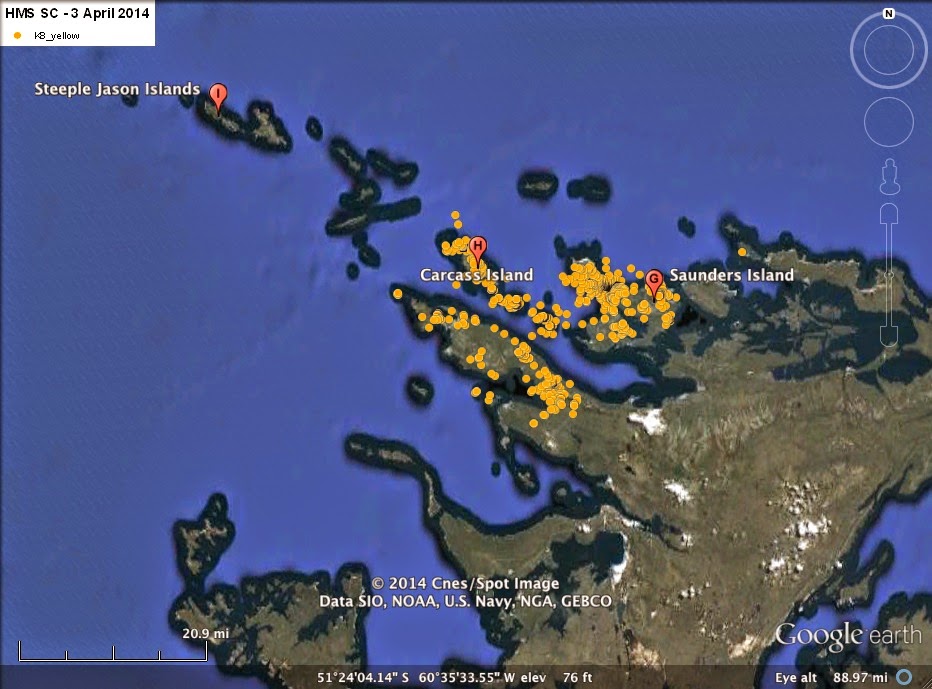
  • 5 GPS transmitters are currently up and active
    • 2 GPS transmitters are currently MIA
(click photo to make larger)
U3 White (fledgling)
Deployed: 25 Feb 2014 on CCI
M0 White (Juvenile)
Deployed 8 February 2014 on SDI

K8 Yellow (Juvenile)
Deployed 1 September 2013 on CCI
G0 Yellow (Adult)
Deployed 18 August 2013 on SDI

P5 Yellow (Subadult)
Deployed 15 August 2013 on SDI

What We Still Need
Help from You!
Whether, you have found this link via Facebook or by word-of-mouth, if you reading it and live in the Falklands or have visited the islands, we are asking you for help. Re-sightings of banded birds are critical data we need collected for this project. Suzan Pole-Evans has gone above-and-beyond the call of duty, and has provided us with over 4,000(!) re-sightings of banded Johnny Rooks that come to Saunders Island. We also have received some sightings from Dunbar Island. However, we are lacking sightings from the other outer islands. Even if they are of the same birds, day after day, this is still important. We want to determine if these birds move amongst islands based on their age, and we would also like to determine the sex-ratio for each island. These birds are highly curious so reading most bands is not difficult. On the ones that are, the color of the band and the leg the band is on are still important bits of information. So please, take a moment to record and report the bands to here, the Facebook page, to raptors@conservation.org.fk, or directly to me at melissa.bobowski@gmail.com

In the coming weeks, I will hopefully be posting links to the videos of the puzzles and other photos from the field. 

Thanks for reading and following along during this field season!
-Melissa Bobowski, MSc.


Sunday, March 23, 2014

Just sit right back and youll hear a tale, a tale of a fateful trip...

"...and here is the steeple..."
What an amazing 5 days spent on Steeple Jason! Steeple is just one island of 5 that make up the “Jason” Islands. The others are:
  1. South Jason (located most south out of the five)
  2. Elephant Jason (yes, it does look like an elephants head if you use some imagination)
  3. Grand Jason (not sure on why this is named, it is quite large I guess)
  4. Flat Jason (aptly named)
Wandering Wanderer?
The day we left (16 March) couldn’t have been better. The sun was out, but most importantly, the wind was low making for calm seas.  We all spent the majority of the 5-hour trip out on deck of the Condor. Right away we were greeted by a pod of Peale’s dolphins, which was exciting because I had yet to see that species. They followed the Condor for a few minutes and then re-disappeared into the kelp to forage. As we reached the Jasons we large flocks of Greater Shearwaters (Puffinus gravis), Sooty Shearwaters (Puffinus griseus), Falkland Diving Petrels (Pelecanoides urinatrix berard), and South American Terns (Sterna hirundinacea). Mike, the captain of the Condor, turned towards the flocks and we saw what all the excitement was about. In the crystal blue waters we could see millions of small fish near the surface and a little farther beneath the surface were larger fish (no idea what they were though). It reminded me of scenes from the movie Life of Pi. Another pod of Peale’s dolphins joined the boat again and this time I was able to record a short video of them jumping in and out of the water next to the bow of the boat. It wasn’t long until I was able to see and add my second species of albatross to my life list – the Southern Royal Albatross (Diomedea melanophris). Then out of nowhere, a huge white albatross flew near the bow of the boat. Of course, none of the 6 people with cameras (me included) were expecting this, so we are left with blurry photos of what could possibly have been a Wandering Albatross (Diomedea exulans). After all of these birds we were greeted by a new species of mammal in the form of hundreds of Fur Seals. They playfully swam and jumped around the boat as well as, looked on from their rocky islands that jutted out above the sea.

WCS house

Mobile Banding Station


We arrived to Steeple Jason and anchored slightly offshore. We loaded the zodiac with all our luggage and gear, and I finally understood why Micky thought I should have brought a smaller bag. Reason? There isn’t exactly a beach. Instead, there is a shoreline of very large rocks positioned “conveniently” on slants. We formed a bucket brigade line and slowly but surely all the gear, luggage, and food (2 dozen eggs included) made it safely to the ground above us. Steeple and Grand Jason Islands were both gifted to Wildlife Conservation Society (WCS). A few years ago they built a very nice house (3 bedrooms, 2 bath, sleeps 7 comfortably) on Steeple Jason. The garage behind the house, along with the back of the rover, became Micky and I’s second home for three days, as they became our new banding stations. 

Distraction is step one of albatross wrangling. 
I think looking like a clown in my waterproofs was my first try at distraction. 
When that didn't work, distraction with my other hand sometimes worked.

On the first day we were on the island, Micky and I helped Andy (also from Falklands Conservation) and his volunteer, Joost, help band Black-browed Albatross nestlings. Don’t begin to picture small young birds though. These were already almost as big as their parents! These birds are also literally born on a pedestal, where they will spend the first 4 months of their lives being doted on by their parents. Seeing them is one thing, but banding them is another type of experience. I have obviously banded raptors, but I also have banded songbirds and a species of shorebird called Black Skimmers. I have even assisted in the banding of Brown Pelican nestlings. So I have had my fair share of being bitten, footed, pooped on, and even the pelican nestlings tried throwing up on you when you go to restrain them as a last ditch defense. 

However, none of those species prepared me for these albatross nestlings. First, they will begin to clap their beaks together as a sign of defense toward you. When that doesn't deter you, they will try to bite you as you pass by. If you are still within their personal bubble projectile vomit happens. Vomit that is orange in color and possesses an extremely potent aroma of warm seafood mixed with gastric acid. Sometimes you will even be gifted with whole Loligo squid or copious amounts of fairly large lobster krill. Although the waterproofs that were provided to me were about 5 sizes too big, I was very grateful to have them on. I took Micky’s advice and swapped into the 4 sizes too big of Wellies after lunch, but I don’t think the smell will be coming off my hiking boots anytime soon. My ever-faithful banding gloves were unfortunately forced into an early retirement and did not make it on the boat ride home. After banding 25 nestlings I did develop the “Bobowski technique for calming albatross.” Thinking about how parents will  devotedly preen their young and one another, I started to rub that same area (right behind the mandible/jaw) while holding the nestling and it was like magic! They would calm right down and would even stay almost asleep in my arms when Micky was done putting the band on. Once I stopped though, they quickly realized I was not their parent and they would start attempting to bite me again.

Playing tug-of-war.
After a half-day of banding albatross, Micky and I devoted the rest of our time to putting on all the bands we brought with us (much to the irritation of my neck). We even discovered that we didn’t even need meat to trap some of the Johnny Rooks because they had a weird fascination with string. We banded near the house and at either side of the main island in the elements, which included rain, hail, and strong winds, all on the last day. But we did it! We banded and bled a total of 82 new Johnny Rooks. On 44/82 rooks we also took 11 different morphometric measurements. Once we learn what the sexes are of all the birds we banded, I hope to statistically analyze the measurements we have taken and determine an average measurement that one could take to determine the sex of the bird without the need of taking blood. 

The only thing we didn't accomplish was finding the transmitter that fell off of M1 White in December 2013. The last location we have of it is in the middle of tussac. It literally felt like trying to find a needle in a field of haystacks. Haystacks that are usually 5+ feet tall! Micky stayed back on the island with another BBC film crew though, so hopefully he will have better luck in the next few days. We did spot M1 White on our last day, so it is still nice to know he is still alive and has molted into a beautiful adult.

I spy with my little eye a $4000 transmitter...


On the day before we left, Micky and I ventured to the world’s largest Black-browed Albatross colony and it was simply incredible. So many birds in one place, I don’t think I was even able to capture it with a photograph. 


On the last day, we packed and cleaned up and boarded the Condor yesterday in slightly less-pleasant weather conditions. I spent the majority of the journey attempting to fall asleep until we reached Carcass Island. This morning I was able to do a crop walk (a survey to see what Johnny Rooks are around) and they seemed to have decreased in number since we were last there a couple of weeks ago with Marc and Keith.

Where do they go!?

It was then a short 10-minute slightly bumpy flight back to Saunders Island where I am currently. Seems strange to be here alone again though, almost makes me miss Micky and I sarcastically bantering with one another. ;-) It only dawned on me today, when I looked at the date on my watch, that at this time next week I would be in the air and/or in an airport. Not to mention I will be turning 26! Ironically, this is the first birthday I could have at home in a number of years and I am still not home. Oh well, I can’t wait to celebrate my dad’s birthday too when I get home! In the meantime, more crop walks here at the settlement of Saunders and hopefully enough Rooks are around to try out some puzzles on them. As girly as it sounds, I can’t wait to wear normal clothes and shoes again. Michigan, you better have spring weather for my return!